PROCEDURE
-3 specimens of about 35 x 35 cm are required. These dimensions must represent all the physical and colorimetric characteristics of the fabric. These specimens are conditioned for at least 4 hours at 20 ± 2 ºC and 65 ± 4 % RH. See ISO 139. The tests will be done within 30 minutes after conditioning.
-Place the flat specimen on white textile blotting paper on a smooth, horizontal surface with the test side facing upwards. It is recommended that the tests be carried out in a standardised atmosphere.
-In case of testing open or “thin” tissues, place the specimen on at least two layers of the substrate, otherwise, it may happen that the test liquid moistens the lower layer and not the tissue under test, giving false results.
-With clean laboratory gloves, brush the hair of the fabric with our hands, if any, in the direction that provides the largest possible extension of surface (direction that the height of the hair is the lowest), before depositing the drops of the normalized liquids.
-We start the trial with the liquid whose key number is lower (liquid no. 1). We carefully deposit small droplets (5 mm in diameter or approx. 0.05 ml) on top of the specimen in at least 5 places where they represent all the colorimetric and physical characteristics of the tissue. Exceptional action can be taken when the degree of repellency of the fabric is known. In this case, the liquid with the lowest grade should be 2 below the known degree of repellency. These droplets should have a distance between them of about 4.0 cm. It is recommended that the tip of the dropper be at a height of about 0.6 cm from the surface of the test fabric.
-We observed the droplets deposited for 30 ± 2 s at an angle of 45 º.
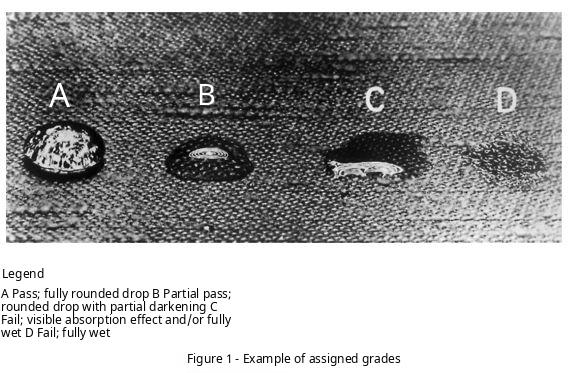
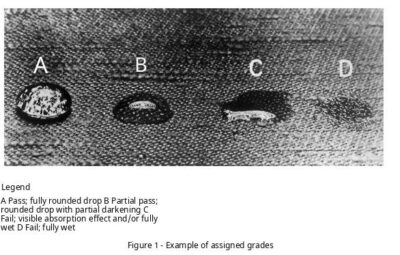
-We evaluate each drop according to image. We immediately examine the back of the fabric for any possible wetting.
-If no penetration or wetting of the tissue is detected, or no absorption effect occurs around the droplets, the droplets of the test liquid with the next higher key number are deposited in an adjacent location on the surface of the tissue in such a way that it does not interfere with the previous test. The procedure of observation of both the gout and the reverse side of the tissue is repeated.
-The procedure is repeated until a visible wetting of the tissues or until the absorption effect is seen at the site of the drops or around being in an interval of 30 ± 2 s.
-A maximum of 6 tests (different liquids) can be performed on each specimen.
-We repeat the test with the second test tube. A 3rd sample may be necessary.
EVALUATION OF RESULTS
-The degree of repellency is the numerical value of the test liquid that has the highest key number that has not been wetted by the tissue in the Test Interval. The value “0” is assigned when the tissue is completely penetrated by the white mineral oil.
-Wetting of the fabric is generally a darkening (shadowing) of the liquid-tissue contact area due to the absorption effect and/or a loss of the contact angle of the droplet. In dark or black fabrics, wetting with loss of “shine” of the drop can be observed.
-Due to the different types of fabrics (fibers, construction…) there may be different types of wetting so in some cases it may be difficult to determine the final point. When the resistance is complete in a test liquid but is quickly penetrated by the test liquid with a higher key number determine the endpoint and the degree of repellency is clearly visible. When the tissue is progressively wetted by test liquids demonstrating a partial darkening of the tissue in the test area (Examples B, C and D in the image above) we will consider a point of failure when the test liquid has caused a total darkening of the contact area or an absorption effect in the test interval.
-Failure is considered when 3 or more drops of the same liquid cause complete wetting (example D in the image above) or an absorption effect with loss of contact angle (example C in the image). Therefore, it will be a “PASS” when 3 or more than 5 drops of the same liquid have a rounded appearance and a high contact angle (example A in the image).
-The grade will be expressed as the whole value of the key number of the test fluid that has passed, immediately above the test fluid that has failed. In the event that 3 or more than 5 drops have a round shape, but have caused a partial darkening of the tissue (example B of the tissue), the grade shall be expressed as the nearest value 0.5, determined by subtracting half a key number from the test liquid of the operation considered partial.
-It is advisable to measure separately the degree of repellency of the same oil on 2 different specimens. In case the grades obtained coincide, the value obtained will be awarded. Otherwise, a 3rd specimen will be necessary and this will be the value that will be given in case it agrees with any of the 2 previous specimens. If not, the average value will be made. (For example, if we have obtained degree 3.0, 4.0 and 4.5, the final value will be the median, in this case 4.0). The grade variation obtained between specimens may indicate inhomogeneous tissue or contamination problems.