• Start
  • About us
  • Products
    • Fabrics
      • Europe Catalog
      • America Catalog
    • ECO products
    • Accessories
    • Knitwear
  • Normative
  • Sustainability
  • Vídeos
  • News
    • Fairs
    • New products
    • Newsletter
    • Lenard MX
  • contact
  • English
  • French
  • German
  • Spanish
Search
Menu
Search
844 Denim
Back to products
720

UNE-EN ISO 14419:2025

OIL REPELLENCY. HYDRICARBON RESISTANCE TEST. Equivalence with EN ISO 14419:2025 & ISO 14419:2025.

  • OBJECT
  • MATERIALS AND EQUIPEMENT
  • PROCEDURE AND RESULTS

OBJECT

PURPOSE AND SCOPE OF APPLICATION

This standard specifies the method for evaluating the resistance of a fabric to the absorption of a series of liquid hydrocarbons with different surface tensions.

This standard serves as a guide for determining the resistance of fabrics to oil stains. The higher the degree of oil repellency, the better the resistance to staining by oily products, particularly liquid substances.

It can also be used to determine if washing and/or dry cleaning treatments have any adverse effects on the oil-repellent characteristics of fabrics. (Washing treatments are described in ISO 6330 and ISO 3175).

The resistance of fabrics to stains caused by oily products can also be influenced by other factors such as the composition, viscosity, nature and design of the fabric, as well as the type of fibres, dyes and finishing products.

This standard does not apply to the evaluation of resistance to penetration of oil-based chemicals.


PRINCIPLE OF THE METHOD

Droplets of standardized test liquids are deposited on the fabric corresponding to a series of selected hydrocarbons with different surface tensions. The penetration of the droplets, the absorption effect and the angle of contact are observed.

The degree of oil repellency is equal to the key number of the highest test liquid among those tested that has not been absorbed by the surface of the fabric.

MATERIALS AND EQUIPEMENT

REAGENTS

All reagents used must be of analytical quality and standardized for the assay. The purity of the liquid affects the surface tension of the liquid. They should be stored at a temperature of 20 ± 2 ºC and will have a shelf life of 3 years.

Standardized Liquids for Testing

Composition Liquid oil test number Density (kg/l) Surface tension (N/m at 25ºC)
None (falls with white mineral oil 0 – –
White Mineral Oil (CAS 8042-7-5) 1 0,84 – 0,87 0,0315
65:35 White Mineral Oil: n-hexadecan by volume 2 0,82 0,0296
N-hexadecan 3 0,77 0,0273
n-tetradecano 4 0,76 0,0264
n-dodecane 5 0,75 0,0247
n-dean 6 0,73 0,0235
N-Octane 7 0,70 0,0214


MATERIAL

-Dropper counter, marked with the key number of the test liquid where the liquids of the corresponding stock solutions will be transferred. A useful system consists of a 60 ml dropper equipped with frosted pipettes with neoprene bulbs. It is advisable to immerse these bulbs in heptane several hours before use and then rinse them in a new heptane solution to remove any soluble substances. A useful procedure may be to place the liquids to be tested in sequential order on a wooden platform above the test pole.

-Absorbent white textile blotting paper 0.71 ± 0.10 mm thick with a weight of 350 g/m2 ± 5% and an absorption capacity of 220 ± 30%

-Laboratory gloves

-It is recommended that the material and work bag be free of silicone as these can have an unfavourable influence on the degrees of oil repellency.

PROCEDURE AND RESULTS

PROCEDURE

-3 specimens of about 35 x 35 cm are required. These dimensions must represent all the physical and colorimetric characteristics of the fabric. These specimens are conditioned for at least 4 hours at 20 ± 2 ºC and 65 ± 4 % RH. See ISO 139. The tests will be done within 30 minutes after conditioning.

-Place the flat specimen on white textile blotting paper on a smooth, horizontal surface with the test side facing upwards. It is recommended that the tests be carried out in a standardised atmosphere.

-In case of testing open or “thin” tissues, place the specimen on at least two layers of the substrate, otherwise, it may happen that the test liquid moistens the lower layer and not the tissue under test, giving false results.

-With clean laboratory gloves, brush the hair of the fabric with our hands, if any, in the direction that provides the largest possible extension of surface (direction that the height of the hair is the lowest), before depositing the drops of the normalized liquids.

-We start the trial with the liquid whose key number is lower (liquid no. 1). We carefully deposit small droplets (5 mm in diameter or approx. 0.05 ml) on top of the specimen in at least 5 places where they represent all the colorimetric and physical characteristics of the tissue. Exceptional action can be taken when the degree of repellency of the fabric is known. In this case, the liquid with the lowest grade should be 2 below the known degree of repellency. These droplets should have a distance between them of about 4.0 cm. It is recommended that the tip of the dropper be at a height of about 0.6 cm from the surface of the test fabric.

-We observed the droplets deposited for 30 ± 2 s at an angle of 45 º.

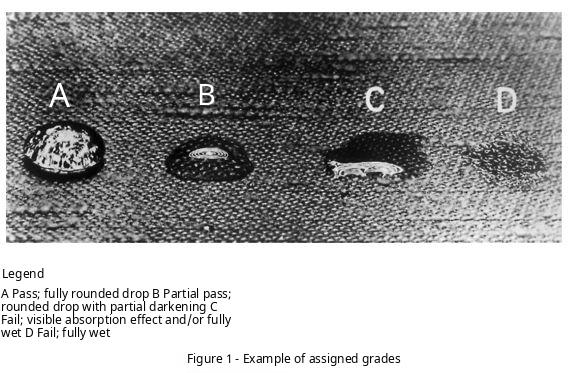
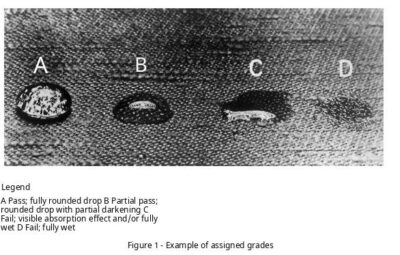
-We evaluate each drop according to image. We immediately examine the back of the fabric for any possible wetting.
-If no penetration or wetting of the tissue is detected, or no absorption effect occurs around the droplets, the droplets of the test liquid with the next higher key number are deposited in an adjacent location on the surface of the tissue in such a way that it does not interfere with the previous test. The procedure of observation of both the gout and the reverse side of the tissue is repeated.

-The procedure is repeated until a visible wetting of the tissues or until the absorption effect is seen at the site of the drops or around being in an interval of 30 ± 2 s.

-A maximum of 6 tests (different liquids) can be performed on each specimen.

-We repeat the test with the second test tube. A 3rd sample may be necessary.


EVALUATION OF RESULTS

-The degree of repellency is the numerical value of the test liquid that has the highest key number that has not been wetted by the tissue in the Test Interval. The value “0” is assigned when the tissue is completely penetrated by the white mineral oil.

-Wetting of the fabric is generally a darkening (shadowing) of the liquid-tissue contact area due to the absorption effect and/or a loss of the contact angle of the droplet. In dark or black fabrics, wetting with loss of “shine” of the drop can be observed.

-Due to the different types of fabrics (fibers, construction…) there may be different types of wetting so in some cases it may be difficult to determine the final point. When the resistance is complete in a test liquid but is quickly penetrated by the test liquid with a higher key number determine the endpoint and the degree of repellency is clearly visible. When the tissue is progressively wetted by test liquids demonstrating a partial darkening of the tissue in the test area (Examples B, C and D in the image above) we will consider a point of failure when the test liquid has caused a total darkening of the contact area or an absorption effect in the test interval.

-Failure is considered when 3 or more drops of the same liquid cause complete wetting (example D in the image above) or an absorption effect with loss of contact angle (example C in the image). Therefore, it will be a “PASS” when 3 or more than 5 drops of the same liquid have a rounded appearance and a high contact angle (example A in the image).

-The grade will be expressed as the whole value of the key number of the test fluid that has passed, immediately above the test fluid that has failed. In the event that 3 or more than 5 drops have a round shape, but have caused a partial darkening of the tissue (example B of the tissue), the grade shall be expressed as the nearest value 0.5, determined by subtracting half a key number from the test liquid of the operation considered partial.

-It is advisable to measure separately the degree of repellency of the same oil on 2 different specimens. In case the grades obtained coincide, the value obtained will be awarded. Otherwise, a 3rd specimen will be necessary and this will be the value that will be given in case it agrees with any of the 2 previous specimens. If not, the average value will be made. (For example, if we have obtained degree 3.0, 4.0 and 4.5, the final value will be the median, in this case 4.0). The grade variation obtained between specimens may indicate inhomogeneous tissue or contamination problems.

Compare
Add to wishlist
Category: Normative

Development and innovation of technical fabrics: THAT IS LENARD. Founded in 1996 by people with extensive experience in the textile sector, it has stood out since its beginning for a strong commitment to innovation and personal protection through the use of new fibers and manufacturing methods with the most advanced technology. Its wide range of fabrics offers protection for different sectors, complying with the requirements established by international certifications.

Latest news
  • ASSP SAFETY 2026
    15 de June de 2026 No Comments
  • 822 XISPAL RS AA
    27 de May de 2026 No Comments
  • AAFF FINISH
    20 de May de 2026 No Comments
  • 517 RP ANTISTATIC
    13 de May de 2026 No Comments

LENARD BCN, S.L.

Avda. Aragón nº37 - 22520 Fraga (Huesca)
info@lenard.tech
How to get

CENTRO OPERATIVO / HEADQUARTERS

Pol. Ind. Sot dels Pradals
C/ Sabadell, 3
08500 - Vic (Barcelona) Spain
How to get

LENARD MX, S de RL de CV

Rio Atoyac 30. Parque Industrial Empresarial Cuautlancingo
Cuautlancingo, 72730 Puebla (México)
+52 222 2319969
jisanchez@lenard.tech
How to get

LENARD USA CORP

2655-Lejeune Rd., Suite 810
Coral Gables, FL. 33134 (USA
+52 222 2319969
fcastejon@lenard.tech
How to get

LENARD Diseño web: Infoactiva't.
Aviso legal | Política de privacidad | Política de cookies
  • Start
  • About us
  • Products
    • Fabrics
      • Europe Catalog
      • America Catalog
    • ECO products
    • Accessories
    • Knitwear
  • Normative
  • Sustainability
  • Vídeos
  • News
    • Fairs
    • New products
    • Newsletter
    • Lenard MX
  • contact
  • English
  • French
  • German
  • Spanish
  • Wishlist
  • Compare
  • Login / Register
Start typing to see products you are looking for.

We are using cookies to give you the best experience on our website.

You can find out more about which cookies we are using or switch them off in .

Privacy Overview

This website uses cookies so that we can provide you with the best user experience possible. Cookie information is stored in your browser and performs functions such as recognising you when you return to our website and helping our team to understand which sections of the website you find most interesting and useful.

Strictly Necessary Cookies

Strictly Necessary Cookie should be enabled at all times so that we can save your preferences for cookie settings.

If you disable this cookie, we will not be able to save your preferences. This means that every time you visit this website you will need to enable or disable cookies again.

3rd Party Cookies

This website uses Google Analytics to collect anonymous information such as the number of visitors to the site, and the most popular pages.

Keeping this cookie enabled helps us to improve our website.

Please enable Strictly Necessary Cookies first so that we can save your preferences!