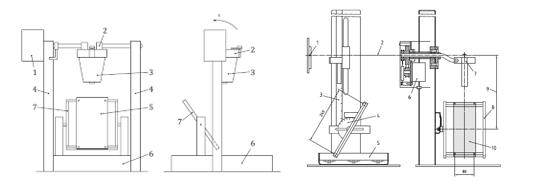
CONDITIONING
Minimum 24 h at 20 ± 2 ºC and 65 ± 5% RH.
The test should be carried out immediately after conditioning. If this cannot be done immediately, store the samples in a sealed container. Each sample should be analyzed within 2 min after conditioning.
To carry out the test, an atmosphere free of air currents is required and the temperature must be between 10 and 30 ºC with a relative humidity between 15 – 80%.
SAMPLE PREPARATION
Prepare 7 specimens in the warp direction. Mark the location of the spikes on the specimens so that the specimen can be nailed to the sample holder without tension or wrinkles.
Prepare a similar number of PVC sheets but without marking the position of the skewers.
ESSAY PREPARATION
Preparation of the equipment: adjust the position of the pouring apparatus to the height specified in Annex A depending on the molten metal to be used. The height should be the vertical distance between the drive shaft and the center of the specimen holder (see table).
Preparation of the molten metal or cryolite: Add the required amount of metal or cryolite to the dry crucible and melt at a temperature slightly higher than that required to melt the metal and perform the test (see melt temperatures in the table).
Placement of the sample and PVC sheet: Put a PVC sheet on the specimen holder. The metal stand can be used or not according to the table. Place the specimen on top of the PVC sheet and press at the points indicated on the specimen so that it is hooked on the spikes and ensure that the specimen and the sheet are in contact and their surfaces are free of wrinkles. In addition, ensure that the layer that is exposed to the molten metal splash is the external face of the garment.
Pouring: Carefully place the crucible with the molten metal into the pouring apparatus. Wait for the molten metal to have the required pouring temperature and once the temperature is reached, activate the pouring apparatus in such a way that the crucible rotates at least 130 º from the horizontal at a constant rate of 36.0 ± 2.5 º per second (this ratio is equivalent to a 90º rotation in 2.5 ± 0.2 s). In the case of using cryolite, the discharge rate should be 18.0 ± 1.5º per second.
| Metal |
Melting temperature (ºC) |
Discharge temperature (ºC) |
Pouring height (mm) |
Angle of inclination the sample from the horizontal (º) |
Using Support Plate |
| Aluminum
(min 99.5%) |
820 |
780 ± 20 |
225 ± 5 |
60 ± 1 |
NO |
| Copper
(min 99%) |
1350 |
1280 ± 20 |
225 ± 5 |
60 ± 1 |
YES |
| Iron
(min. 93%) also containing:
-C 2.8 – 3.2 %
-Yes 1.2 – 2.0 %
-P 0.3 – 0.6 % |
1500 |
1400 ± 20 |
225 ± 5 |
60 ± 1 |
YES |
| Steel according to designation C25 specified in ISO 683-1 |
1650 |
1550 ± 20 |
225 ± 5 |
60 ± 1 |
YES |
| Industrial Grade Cryolite |
1200 |
1120 ± 20 |
300 ± 5 |
70 ± 1 |
NO |
Ensure that the pour is made from the surface of the crucible and also the pour edge is intact. If the crucible is damaged or the pour edge is not intact, it is advisable to discard the crucible.
It is advisable to decontaminate the crucibles between tests to remove solidified residues by scraping and/or baking.
NO METAL OR CRYOLITE SHOULD BE REUSED IF THERE IS EVIDENCE OF CONTAMINATION AND/OR DEGRADATION
ITERATIVE TESTING PROCEDURE
Put in the crucible approximately 50 g previously weighed of the metal or cryolite, or a 50 g manifold if it is known that the material can withstand that amount of molten metal. Melt the metal and pour it. If there is no damage to the PVC sheet, repeat the procedure with a new test tube and PVC sheet using a 50 g amount of molten metal higher than the test performed. If the crucible capacity is reached, the test is not severe enough to obtain damage to the blade. If damage is observed, repeat the test with a 10 g lower amount of metal. If damage is observed in the PVC sheet, repeat with 10 g less metal.
When no damage is observed in the repetitions, repeat the test with the same amount of metal. In case of damage to the film, lose 10 g of weight and repeat the test. If no damage is obtained, repeat with the same amount until 4 successive samples are obtained without damage to the PVC sheet:
Record the highest value of molten metal poured from the 4 successive tests without damage to the sheet and the lowest value that has caused damage.
Average these two values by rounding the result to the nearest gram. The value obtained will be the molten metal index.
PERFORMANCE LEVEL-BASED PROCEDURE
When tested according to a standard (e.g. ISO 11612), the initial amount of the heavy metal must be within the range of the stipulated level. The performance level should be selected based on customer experience or expectations.
In the event that the result meets the requirements of the performance level, a new test will be performed:
To a higher level if the material has not yet failed
At the same level of performance.
Alternatively, if the result does not meet the requirements initially set, a new test can be performed at a lower level. The required number of successive tests should be performed without damage to confirm the level of performance.
ASSESSMENT
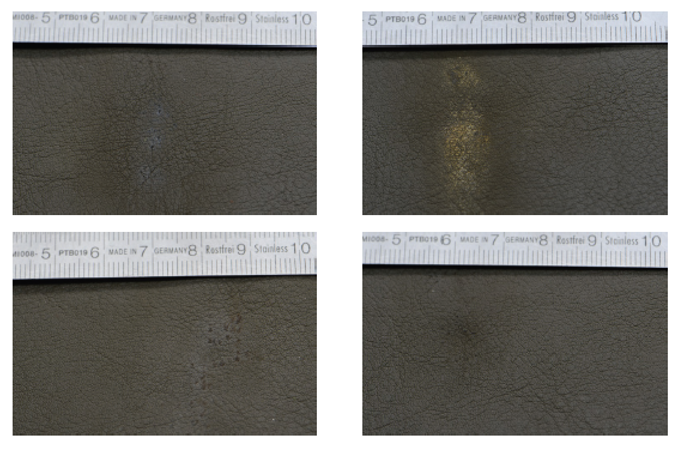
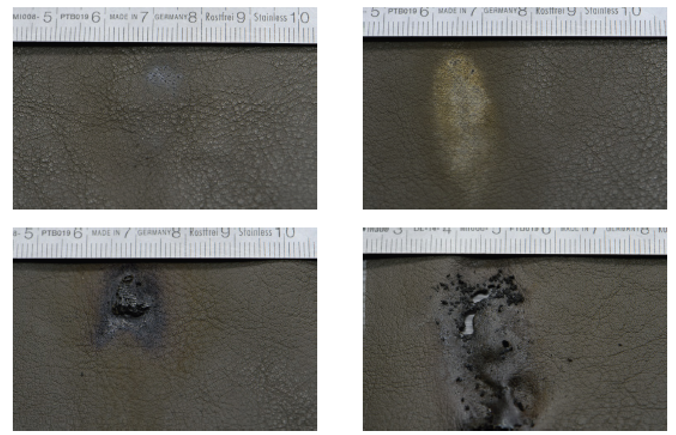
After 30 seconds of pouring, remove the sample and visually examine the PVC sheet for any signs of damage. In the event that the PVC sheet has the sample attached to the sample or small residues, if these can be removed with a soft paper cloth (dry or damp), this can be considered as suitable.
Example of a satisfactory test (Damage less than 5 mm):
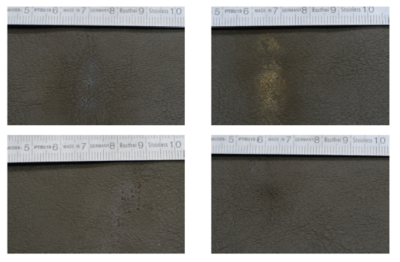
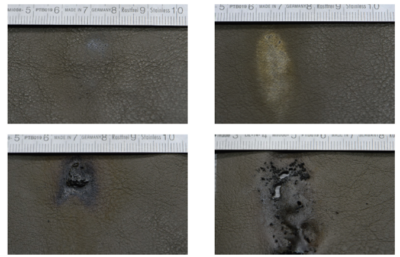
Examples of NOT satisfactory test (Damage greater than 5 mm):
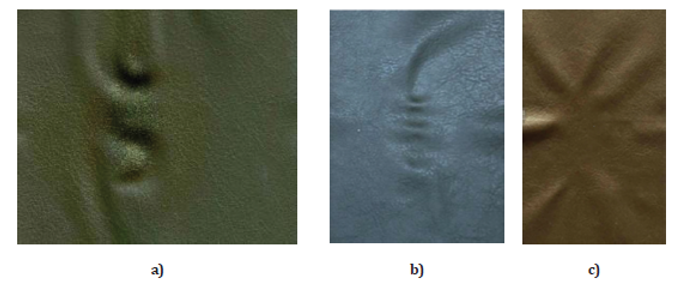
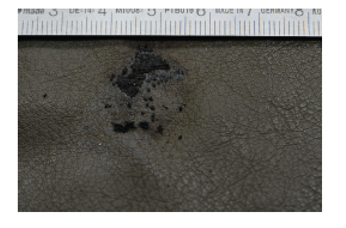
Example of complies/does not comply depending on the result after removing the residue
ANNOTATIONS:
-Melting of the carbonized material to the PVC sheet that cannot be removed is a NON-COMPLIANT.
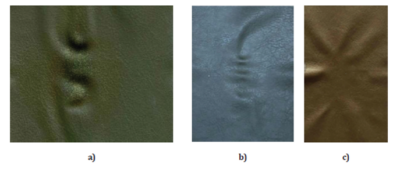
-The undulation can, on certain occasions, be considered damage. Image A is a NOT COMPLIANT and images B and C are a COMPLIANT
Determination of the molten metal mass: Allow the molten metal residue from the crucible to solidify so that it can then be scraped off and removed. Weigh this residue to an accuracy of 1g and subtract it from the initial weight of metal introduced into the crucible. The result will be the molten metal weight.
INVALID ESSAYS
It will be considered an invalid test if any of the following situations occur during the test:
-The impact of the spill moves horizontally in the specimen
-The metal comes out of the specimen or impacts less than 25 m from the upper edge of the specimen.
-Any molten metal does not touch the specimen first.
-The metal is not completely molten when poured
-the PVC sheet ignites due to the metal solidifying in the specimen holder