


This website uses cookies so that we can provide you with the best user experience possible. Cookie information is stored in your browser and performs functions such as recognising you when you return to our website and helping our team to understand which sections of the website you find most interesting and useful.
UNE-EN ISO 13937-2:2001
DEFINITION
This part of EN ISO 13937 describes a unique tear method for determining the tear strength of a fabric, called a test tube trousers, carried out on a specimen cut into the shape of the legs of trousers. The measured tear force is the force necessary for the propagation of a single tear initiated when the force is applied parallel to the notch and the tissue is torn in the direction of the applied force.
The test is mainly applied to openwork fabrics. It can be applied to non-woven fabrics.
In general, the method does not apply to knitted fabrics and stretch fabrics. It is not suitable for very anisotropic tissues or for loosely dense tissues, in which tear propagation is likely to occur from one direction to another.
This method allows only the use of elongation constant gradient testing equipment. For the other tear methods where the equipment is used to determine traction, Part 3 of this standard describes the wing-shaped specimen method; Part 4 with a tab-shaped specimen and Part 1 describes the ballistic pendulum method (Elmendorf method)
DEFINITIONS
-Constant elongation gradient (GCA) test equipment: tensile equipment that has one fixed jaw while the other moves at constant speed throughout the test, with the device as a whole presenting practically no deformation.
-Tear length: distance of tear propagation measured between the beginning and end of the application of force.
-Tear Force: Force required to propagate the initiated tear under the specified conditions.
-Peak: Point of the force/elongation curve where the gradient, depending on the force values recorded, changes from positive to negative.
-Indicator length: distance between the two effective pinching points of a test device.
-Constant gradient elongation machine with a constant elongation speed of 100 ± 1 mm/min, with the option to adjust a test length of 100 ± 1 mm, capable of recording the applied force and with a class 1 accuracy according to ISO 7500-1. In the case of collecting force and elongation data through computer programs, this data collection must be at least 8 per second.
-Pinching device. The width of the jaws should preferably be 75 mm but in no case less than the width of the specimen.
-Equipment for cutting the specimens.
-Conditioning of samples and test atmosphere according to ISO 139.
-Two sets of specimens are cut from each sample, one set in the direction of the warp and the other in the direction of the weft.
Each set must comprise at least five specimens or a greater number, subject to agreement between the parties concerned. No specimen may contain the same longitudinal or transverse threads and no specimen should be cut less than 150 mm from the end of the fabric, avoiding folded, wrinkled or selvedge parts in addition to parts that are not representative of the fabric.
PROCEDURE WITH NARROW SPECIMENS
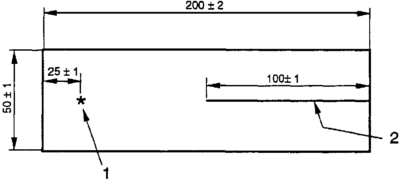
-50 mm wide specimens (Trouser shape): It must be a rectangular strip of 200 ± 2 mm long by 50 ± 1 mm wide; A notch of 100 ± 1 mm in length must be made from the centre of the width. The end of the tear is marked at (25 ± 1) mm from the uncut end of the strip, to indicate the position of the tear at the end of the test.
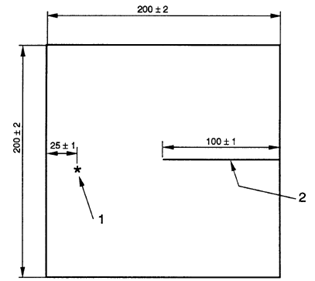
-Specimens with a large width of 200 mm: These can be used by agreement between the interested parties. It is recommended for specimens where 50 mm specimens are considered unsuitable or for particularly tear-resistant fabrics. In case of using this type of specimens, use the specific method for this width.
-Each specimen shall be cut with the length parallel to the direction of the warp or the direction of the weft of the fabric. In specimens where the longest side is parallel to the direction of the warp, the tear shall be classified as “perpendicular to the weft” and for those specimens with the longest side parallel to the direction of the weft the tear shall be qualified as “perpendicular to the warp”.
-We will adjust the length of the traction equipment indicator to 100 mm and the elongation speed to 100 mm/min.
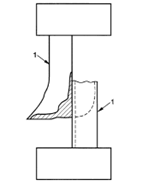
-We will place the specimen in the jaws, with a leg loop in each of the jaws and the notch aligned to the axis that stops in the center of them. The uncut part of the specimen must be left free as can be seen in the image. Ensure that the tear starts parallel to the notch and in the direction of force application. Pre-tensioning should be avoided after the start of the test
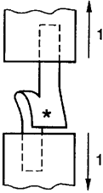
-We started the equipment and the tear force recording. The movable clamp will be activated at a speed of 100 mm/min continuing the tear to the point marked on the other end of the strip.
-We will note the tear force in Newtons.
-If the evaluation of the peaks obtained with dense fabrics comprising a large number of threads/cm is carried out from a graph obtained manually, the ratio between paper speed and elongation speed should be 2:1
-It must be observed if the tear has been made in the direction of application of the force and if the threads have been frayed instead of breaking.
-The test will be considered valid when:
a) there has been no slippage of the threads in the fabric
b) there has been no slippage in the jaws
c) the tear has been completed and has been performed in the direction of application of the force
Any other results should be ruled out.
If the results obtained for 3 specimens or more out of 5 must be rejected, the method is inadequate. In this case, it is advisable to use the method for wide specimens.
PROCEDURE FOR WIDE SPECIMENS:
-This method is used in case it is determined that the method with narrow specimens is inappropriate or for those fabrics that are particularly resistant to tearing (not very dense fabrics, tearless fabrics, tear-resistant fabrics of artificial fibres intended for technical applications such as coating, airbags, etc.). The other widths used will be the subject of agreement between the interested parties.
-To fix the specimen on the jaws, each trouser leg must be folded inwards parallel to the seam, so that the fixed width of each leg corresponds to half of the cutting width.
-All test conditions must be as described in this part of the standard except for the modification of the specimen width previously described.
-For particularly tear-resistant fabrics, it will be necessary to evaluate all peaks (calculation using electronic devices).
-A specially designed tear-resistant fabric can produce “unusual” tear graphics. In this case, it is recommended to agree on the appropriate assessment and include a tear chart.
RESULTS:
-There are two methods for calculating the results, one manual and one electronic. They may not produce the same results and it is advisable not to compare such results obtained by different methods.
1-Manual calculation via tear chart
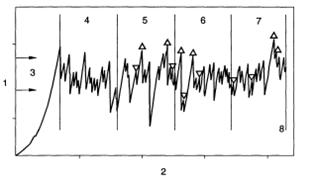 1: Strength
2: Chart Length
3 Range of the approximate average peaks
4: Section Not Taken Into Account
5-6-7: sections 1, 2 and 3 respectively
8: End of the tear
-The graph is divided from the first peak to the last into 4 equal parts. The first section is discarded. The other 3 sections note the values of the 2 highest peaks and the 2 lowest peaks of each section. It is considered an appropriate peak for the calculation when it has an increase and decrease in force of at least 10 %. To facilitate this calculation, take the medium-high peaks on the graph. One-tenth of this value, rounded to ± 10 % indicates the increase and decrease in strength required to characterize a peak.
Example:
Medium-high peaks→ 85 to 90 N
10% of value →8.5 to 9.0 N
Spikes for calculation have an increase/decrease in force of 8 N
-The arithmetic mean of these 12 values is calculated.
-The calculation is repeated for each specimen in the set.
-The arithmetic mean of the set is calculated for each direction tested and the result is rounded to 2 significant figures.
2-Calculation by electronic device
-Using the graph obtained, the graph is divided into 4 equal parts from the first to the last peak. The first section is discarded and all the peaks of the other sections are noted. A peak suitable for calculation has an increase and decrease in force of at least 10 % (see calculation and example in the manual calculation method)
-The arithmetic mean is calculated for each specimen of the peaks used for the calculation
-The arithmetic mean is calculated for the set of specimens in each direction.