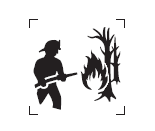
PROTECTIVE CLOTHING FOR FOREST FIREFIGHTERS
PROTECTIVE CLOTHING FOR FIREFIGHTERS. TEST METHODS AND REQUIREMENTS
PROTECTIVE CLOTHING FOR FOREST FIREFIGHTERS
PROTECTIVE CLOTHING FOR FIREFIGHTERS. TEST METHODS AND REQUIREMENTS
SCOPE
This document specifies the test methods and minimum performance requirements for personal protective clothing, designed to protect the wearer’s body, except for the head, hands, feet, eyes and ears used during wildfire suppression and associated activities. This clothing is not intended to provide protection during fire entrapment or structural fire extinguishing, rescue, or to protect against chemical, biological, electrical, or radiation hazards. This document does not provide protection against elevated mechanical hazards such as protection when using chainsaws.
SAMPLES AND PRE-TREATMENT
Samples must be representative. There are tests that are required in original and/or after cleaning.
The pretreatment of the fabric will be 5 cycles and/or according to the manufacturer’s indications
For the flame propagation and heat transfer assay, the assays will be performed before and after pre-treatment.
Before all the tests and after having carried out the specified pre-treatment, the samples will be conditioned according to ISO 139 for a minimum of 24 hours
(20 ± 2 ºC with a relative humidity of 65 ± 5%). Tests must be performed within 5 minutes of removal from the conditioner.
EXPRESSION OF RESULTS:
All test sample results must be reported together with the result calculated according to the test method.
For each test, the corresponding estimate of the coefficient of variation (CV %) for laboratory assay variability (without taking into account sample variability) shall be given.
| TEST METHOD | TEST STANDARD | DESCRIPTION | REQUIREMENTS |
|
DIMENSIONAL STABILITY |
ISO 5077 | % shrinkage after wash cycles according to the fabric manufacturer’s instructions. By default 5 cycles minimum. | Openwork fabric Max. ± 3 % warp/weft Knitted fabric Max. ± 5 % length/width |
| LIMITED FLAME SPREAD | ISO 15025
Method A and B |
Original and pre-treated fabric:
Each component assembly material, range markings, retroreflective and fluorescent materials excluding hardware will be tested separately Application of the 10″ flame perpendicular to the tissue (procedure A) |
No specimens should ignite to the top or to the edges, with no flaming or melted debris; no formation of holes greater than or equal to 5 mm, except for an inner layer used for application other than flame protection; post-ignition and post-luminescence time ≤ 2 s (post-luminescence is considered a residual glow without combustion within the charred area as in ISO 15025) |
| Original and pre-treated fabric:
Assembled Material Flame application to the edge of the fabric with 10″ hem. (procedure B). This test shall also be carried out after the maximum number of cleaning procedures indicated by the manufacturer. |
No specimens should ignite towards the top or to the edges, without burning or melted debris; post-ignition and post-luminescence ≤ 2” (post-luminescence is considered a residual glow without combustion within the charred area as in ISO 15025)
The charred length must be ≤ 100 mm according to ISO 15025 Annex C |
||
| TENSILE STRENGTH | ISO 13934-1 | Pre-treated fabric. | ≥ 600 N warp/weft |
| TEAR RESISTANCE | ISO 13937-2
or Method B (ISO 4674-1) for coated fabrics |
Pre-treated fabric. | ≥ 25 N warp/weft |
| MAIN SEAM STRENGTH | ISO 13935-2 | Pre-treated fabric. | Seam strength ≥ 300 N |
| HEAT RESISTANCE
From the base fabric and trimmings close to the skin and retro-reflective and/or fluorescent materials |
ISO 17493 | Pre-treated fabric subjected to 260 ºC for 5 minutes. | No layer can become inflamed. No layer can melt or drip.
Shrinkage ≤ 10 % at 260 ºC. |
|
HEAT RESISTANCE Retro Reflective and Fluorescent |
ISO 17493 | Pre-treated fabric subjected to
180 ± 5 °C for 5 min ± 15 s |
It must meet the visibility requirements: ISO 20471:2013 6.2.2-6.2.3 or 6.2.4 and the color performance requirements of ISO 20471:2013 5.1. |
| HEAT RESISTANCE | ISO 17493 | Pre-treated fabric
Default: 5 min ± 15 sec exposure at 260 ± 5 °C Fluorescent and retro-reflective materials: 5 min ± 15 sec exposure at 260 ± 5 °C Fittings, fasteners and other materials that are not in contact with the skin: |
No layer can melt, drip, ignite or contract > 10% and remain functional. |
| HEAT RESISTANCE
SEWING THREAD |
ISO 3146 | Hot plate method
Separate sample |
Do not melt at 260 ºC |
| RADIANT HEAT | ISO 6942
Method B |
Original and pre-treated fabric
Heat flux density 20 kw/m2 |
TF ≤ 70% |
| RHTI24 ≥ 11 s | |||
| RHTI24 – RHTI12 ≥ 4 s | |||
| WATER VAPOR RESISTANCE | ISO 11092 | Original fabric, hot plate | Ret ≤ 10 mPa/W |
| THERMAL RESISTANCE | ISO 11092 | Original fabric, hot plate | RCT ≤ 0.055 m2K/W |
| RETRO REFLECTIVE/FLUORESCENT PERFORMANCE | ISO 20471 | Original Fabric
After xenotest After cleaning |
The photometric performance of the retro-reflective part or the combined performance material shall be determined in accordance with ISO 20471:2013. 7.3. The minimum coefficient for new retroreflective material or combined performance material should be in accordance with ISO 20471:2013, Table 4 or 5, as applicable. |
| The combined/fluorescent performance material shall meet the requirements of ISO 20471:2013, 5.1, 5.2 and 7.5.1, for the color performance requirements of the new material, after xenon testing and after cleaning. | |||
| ABRASION RESISTANCE | ISO 12947-2 | Force 12 kPa | ≥ 20,000 cycles |
| INNOCUOUSNESS | ISO 13688 point 4.2 | The material must not release toxic, carcinogenic, mutagenic, allergenic, or toxic substances to reproduction or otherwise harmful |
GARMENT DESIGN
Protective garments can be composed of:
The general requirements must comply with ISO 13688. They must not restrict the user in any of the movements expected to be made during the spread of wildfires, e.g., bending, stretching, and twisting.
Closure systems, label accessories, contact and closure fasteners, retro-reflective and/or fluorescent materials… Attached to personal protective clothing should be designed not to adversely affect the performance of the clothing. These locking systems must prevent debris from entering the flames.
Conformity will be assessed through visual inspection and practical tests
MARKING AND LABELING
Any tag or accessory must not adversely affect the performance of any item to which it is attached or pose a hazard to the wearer.
The durability and legitimacy of the label after washing, heat and abrasion resistance (200 ISO 12947-2 12 kPa cycles) must remain legible.
Each item of protective clothing for which compliance with this standard is declared must bear a permanent and visibly affixed label, on which the following information must be printed in letters of at least 2.0 mm in height: