PROCEDURES:
General for both methods:
-The power supply must provide an alternating arc current of 8 kA±0.5 kA and a duration of at least 1 s.
-A data acquisition system capable of measuring arc stress as well as calorimeter outputs as required in the test is required.
-The samples must be pre-treated before the tests. The pre-treatment must be according to the manufacturer’s instructions. Otherwise, the tests will be done after 5 cleaning cycles.
-The samples will be conditioned for at least 24 hours at 18-28 ºC with a relative humidity of 45-75 %
METHOD A for materials or set of materials:
-It is used to determine the arc characteristic expressed by the ATPV or EBT value, whichever is lower, or by the ELIM if specified by the test applicant.
-The test specimens shall be flat specimens mounted on test panels in such a way as to allow them to shrink during exposure to the arc. In the case of materials with several layers, they shall be mounted in such a way as to represent the normal placement of clothing.
-Due to the variability of arc exposure and tissue construction, at least 20 samples cut in the warp direction are analyzed in order to statistically analyze the results. It is advisable to prepare 30 samples since in case the materials are not homogeneous and/or if the EBT is well above the ATPV, more test samples may be required to determine ATPV and/or EBT.
-The size of the pre-treated samples will be between 100-130 mm longer and wider than the actual panel measurements.
-A 3-panel configuration should be used with two panel sensors each for each test and with a separation of 120º between them.
-The distance from the panel to the arch must be 300 mm for standard testing.
-The data will not be used when the calorimeter temperature exceeds 500 ºC.
-In the sequence of tests, the first objective is to determine the ATPV. If during the test there are 2 or more open breaks at incident energies below the value greater than 20% of the ATPV determination, the EBT must also be determined.
DETERMINATION OF THE ATPV:
-The dataset will be distributed as follows:
-At least 3 data points must be below the mixed zone
-At least 3 data points must be above the mixed zone
-At least 10 data points must be in the range of ± 20 % of the final ATPV
The firing order must provide at least 20 data points, in the order that they meet the distribution requirements discussed.
In the event that the 20 data points obtained are not sufficient to meet the distribution requirements, further test shots will be performed.
At least 3 data points should also be obtained when the incident energy causes ablation on the surface of the innermost layer.
DETERMINATION OF EBT:
-The dataset will be distributed as follows:
-At least 3 data points must be below the mixed zone
-At least 3 data points must be above the mixed zone
-At least 10 data points must be in the range of ± 20 % of the final EBT
-For the calculation, binary answers are used: “0” without breakage and/or contraction, “1” open breakage and/or open contraction.
DETERMINATION OF ELIM:
-For this determination, it is sufficient to have the ATPV or EBT data set if it is lower than the ATPV.
-However, it is not necessary to determine the EBT with the statistical precision required for its calculation if, there is evidence that the EBT is at least 20 % higher than the ATPV.
METHOD B for garments or sets of garments:
-This method is based on what is determined by method A but conditioned by the design and performance of the clothes.
-In this case, the clothing is exposed to an open arch, causing an incident energy on the external face of the clothing equal to or greater than the arch characteristic of the material or assembly that makes up the garment.
-Samples must be finished garments (with pleats, pockets, zippers…) or sets of garments as they will be worn together or on top of each other according to the manufacturer’s instructions.
-The size of the garments must be suitable for the mannequin. More than one test sample may be required.
-Samples in this method shall be mounted on test dummies consisting of at least one torso when intended to protect torso and arms, and shall be tested with the centre of the arc distance at sternum height. In the case of a garment intended for leg protection, the dummy shall consist of at least the lower part of the torso and shall be tested with the centre of the electrode space at the crotch level. If the torso analysis has already analysed the components of the garment, re-testing is not necessary.
In the case of garments with different zippers or with additional design features at the waist, a mannequin with at least one torso with leg stumps should be mounted and tested with the center of the arc distance at the level of the navel.
-If the set of garments are worn one on top of the other, they will be tested with the center of the electrode space at the height corresponding to the outermost garment of the set.
-If more than one mannequin is used, they must have a minimum separation of 120 º. A control sensor will be placed on each side of the mannequin.
-The mannequin will be dressed with a test sample with all closures closed. Zippers should not be cut. Excess materials should be collected behind the mannequin.
-To expose the construction elements to the arch (side seams, closing elements and/or accessories) the mannequin can be rotated 90 º for laterial exposure or 180 º for exhibition from the back.
-The mannequin will be dressed in an untreated white cotton underwear with a maximum weight of 180 g/m2. Its actual weight will be recorded. This underwear is used to subjectively detect the heat transfer of the garment, closure as well as interface area and the release of chemicals to the extent that such release modifies the color of the white undergarment.
-The distance between the arch and the closest point of the surface of the mannequin must be 300 mm.
-The sample must be a finished garment with appropriate measurements for the mannequin. More than one test sample may be required in case of not meeting the visual inspection criteria. The samples will be pre-treated according to the manufacturer’s instructions or if not specified, 5 washing and drying cycles.
-If the manufacturer indicates that an arc characteristic is to be attributed to a garment, made of a material for which the arc characteristics determined in Method A are known, the arc duration must be selected so that the resulting incident energy exposure value is in a range of the arc characteristic of the material.
-At least one sample of garment or set of garments mounted on a mannequin must be analyzed.
-It is recommended to test a sample at the target level of incident energy or equal (e.g. in a range) of the arc characteristic of the material from which it is made, in order to be able to assess whether the value of the material can be attributed to the garment.
-The garment must comply with the visual inspection criteria. If it does not meet these criteria, it cannot be attributed an incident energy value as its arc characteristic. However, one or more additional samples may be tested with reduced incident energies. If the visual evaluation criteria are met, the reduced incident energy value can be assigned to the garment or assembly as an arc characteristic.
-The clothing elements, pockets and closures must be evaluated.
-The sample with the highest incident energy must be selected, complying with the visual inspection requirements and also if there are more samples, those with lower incident energies must also comply with the visual inspection criteria.
-The value obtained must be compared with that of the material. At most, the lower of these 2 values must be attributed to the garment as an arch characteristic. Therefore, the arch characteristic of a garment will never be higher than the arch characteristic of the material of which the garment is made.
RESULTS:
-All sensor temperature responses tª will be converted into thermal energy (kJ/m2)
-The start time of the arc, t0, corresponds to the moment of its start. This tª must be determined for each sensor.
-The heat capacity of the copper, Cp, of each calorimeter [J/(g· K)]
-The incident and transmitted energy that is determined at each moment of the sampling will be calculated for all copper calorimeters.
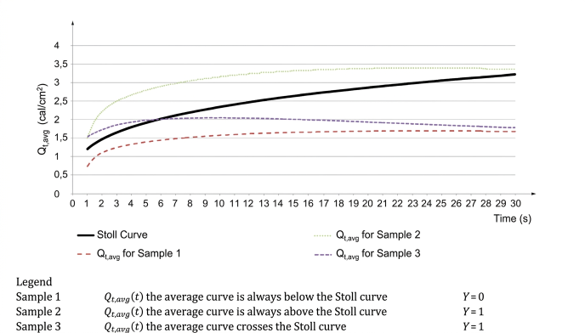
-Using the energy data obtained from the two sensors in each panel, the average transmitted energy data matrix Qt,avg is calculated for each sample tested.
-Stoll Qstoll response will be expressed in kJ/m2.
-In the graph of average values of transmitted energy data obtained for the sample, the Stoll curve will be superimposed in such a way that the incidence of the Stoll curve coincides with the value t0 (the zero value on the x-axis)
-The data from all samples will be compared with the Stell curve. As a result, a binary response will be attributed to the data:
Y=1 if Qt,avg is equal to or greater than the criteria of the Stoll curve between 1 and 30s.
Y=0 if Qt,avg does not exceed the criteria of the Stoll curve in the same time interval.
Determination of ATPV:
-A minimum of 20 samples are required to perform a nominal logistic regression on the data obtained.
-In variable x, the incident energy to which a sample has been exposed will be used from the maximum average incident energy of the control sensor’s response.
-The value “1” corresponding to the Y axis is given if the average response of the panel sensor for the sample is equal to or greater than the Stoll curve between 1 and 30 s. Otherwise, it is given “0”.
-This logistic regression will be used to determine the values of the x and y axes to calculate the probability value of 50 % of exceeding the criteria of the Stoll curve. This will be the ATPV result.
Determination of EBT:
-Evaluation similar to ATPV. The information of open rupture and open contraction of the material is used in addition to the incident energy. An open contraction will be treated as an open rupture.
-A nominal logistic regression of the test data will be carried out. In the graph, the x-axis will be the response of the control sensor to the incident energy and the y-axis will correspond to the open breakage of the material, attributing a nominal value of “1” in the case of breakage or open contraction and “0” otherwise.
-From the regression, the slope and interception values will be determined to calculate the probability value of 50% of open rupture of the material, this being the EBT value.
ELIM Determination:
-A binary response value will be recorded being Y=1 for each point that reaches or exceeds the stoll curve in terms of incident energy in an interval of 1-30 s and Y=0 for those points that do not.
-The average of the 3 data points where the incident energy is the highest just below the mixed zone (Y=0) will be calculated. In case the mixed zone is empty, the ELIM will be the average of the 3 highest incident energy data points in open breakage, open contraction and without reaching or exceeding the Stell curve.
VISUAL INSPECTION:
The effects of exposure of the material or garment shall be observed during the arc exposure, after the exposure of the arc before the material is removed from the panel or clothing of the manikin, and after the specimens are cooled and carefully removed from the panels or mannequins.
VISUAL INSPECTION PERFORMANCE RATING AND REPORTING REQUIREMENTS
| |
|
Reporting requirements and performance qualification of visual inspection in case of tests in accordance with |
| Observed effect |
Time/Duration of Observation |
Method A |
Method B |
| Open break |
Before removing from the panel/dummy |
“Yes” or “No”. |
“Yes” or “No” (optionally indicate the location and size of the open break area) |
| Ablation |
Before removing from the panel/dummy |
“Yes” or “No” [indicate which layer(s)] |
“Yes” or “No” [indicate which layer(s) and optionally the location and size of the ablation area] |
| Open contraction |
Before removing from the panel |
“Yes” or “No”. |
Not applicable |
| Melting and/or dripping |
During exposure to the arch and until removed from the panel/mannequin |
“Yes” or “No”. |
| Inflammation |
During exposure to the arch and until removed from the panel/mannequin |
“Yes” or “No”. |
“Yes” or “No”. (optionally indicate the location and size of the area of inflammation) |
| Post-flame time |
After exposure to the arc until removal of the panel/mannequin |
Time, rounded to full seconds |
Rounded time(s) to full seconds and burning area(s) |
| In case of inflammation, self-extinguishing |
During exposure to the arch and until removed from the panel/mannequin |
“Yes” or “No”. |
| Carbonization |
Before and after removing from the panel/manikin |
“Yes” or “No” (reporting location and size of charred area is optional) |
| Fragilization |
After removing from the panel/mannequin |
“Yes” or “No” (reporting the location and size of the fragile area is optional) |
| Stretching and contraction |
After removing from the panel/mannequin |
Stretching of the material, or no shrinkage, or moderate shrinkage or excessive shrinkage |
| Operation of closures that are essential for quickly undressing test clothing after exposure to the arc |
Before removing from the panel/dummy |
“Yes” or “No” (applicable in case of optional tests with materials with closures) |
“Yes” or “No”. |
| Operation of other closures and/or closures of garment accessories (e.g. pockets) |
Before removing from the panel/dummy |
“Yes” or “No” (applicable in case of optional tests with materials with closures) |
“Yes” or “No”. |
| Color change |
Before and after removing from the panel/manikin |
“Yes” or “No” and description of the color change |
| Color Change of White Cotton Underwear |
On the mannequin after removing the rehearsed clothing |
Not applicable |
“Yes” or “No” and description(s) and location(s) of color change |
In the case of tests on garments with method B, the effect of exposure of the underwear must be described according to the table above.
ARC CHARACTERISTIC OF A MATERIAL OR SET OF MATERIALS
-The ATPV will be considered as the arc characteristic of the material or set of materials tested if it has not been necessary to also determine the EBT or, if it has been determined and it is above the ATPV.
-In case the EBT is below the ATPV, this will be considered as the arc characteristic of the material or set of materials.
-If it has been specified that the arc characteristic will be given by the value of the ELIM and not by ATPV or EBT, the ELIM must be determined and considered.
ARCH CHARACTERISTIC OF A GARMENT OR SET OF GARMENTS
-Before using method B for determination, the arch characteristic must be determined according to method A, in order to attribute an arc characteristic to the garment or set of garments.
-The effects observed on all components of the garment or set of garments other than the material or materials from which the garment or set of garments is made must be visually evaluated according to the following table:
VISUAL EVALUATION CRITERIA FOR GARMENTS OR SETS OF GARMENTS ACCORDING TO METHOD B
| Observed effects |
Observation Time/Duration |
Visual Evaluation Criteria |
Observed effects that do not affect the arc characteristic but should be considered |
| Melting and/or dripping |
During exposure to the arch and until removed from the mannequin |
No drips or traces of melted flames from components (e.g. sewing thread, fasteners, buttons, reflective tapes, logos, labels, embroidery, belts) |
Drip-free component fusion and melted flame residues |
| Fusion |
After removing from the mannequin |
No fusion of components (e.g. sewing thread, fasteners, buttons, reflective tapes, logos, labels, embroidery, belts) |
|
| Post-flame time |
After exposure to the bow and until removing from the mannequin |
No components burn for more than 5 s after exposure to the arch (e.g. sewing thread, fasteners, buttons, reflective tapes, logos, labels, embroidery, belts) |
This criterion is not applicable for labels, embroidery or other decorations added with an area of less than 10 cm2 (see ISO 11612:2015 point 6.3.2.4) |
| Operation of closures that are essential for quickly undressing test clothing after exposure to the arc |
When removing from the dummy |
Starting from the closed clothing until it is fully opened, the action of opening it by one person will not last more than 30 s. (see IEC 61482-2:2015 point 5.2.5) |
|
| Open break (if the arc characteristic is given as the ELIM) |
Before removing from the mannequin |
No open tear through all layers of the test clothing |
The criterion is not acceptable in case the arc characteristic is given as ATPV or EBT |