• Start
  • About us
  • Products
    • Fabrics
      • Europe Catalog
      • America Catalog
    • ECO products
    • Accessories
    • Knitwear
  • Normative
  • Sustainability
  • Vídeos
  • News
    • Fairs
    • New products
    • Newsletter
    • Lenard MX
  • contact
  • English
  • French
  • German
  • Spanish
Search
Menu
Search
Placeholder
UNE-EN 16689:2017
Back to products
Placeholder
UNE-EN ISO 6942:2023

UNE-EN 17353:2020+A1:2025

UNE-EN 17353:2020+A1:2025. PROTECTIVE CLOTHING. ENHANCED VISIBILITY EQUIPMENT FOR MEDIUM RISK SITUATIONS. REQUIREMENTS AND TEST METHODS. Equivalence with EN 17353:2020 A1:2025.

  • OBJECT
  • REQUIREMENTS
  • GARMENTS
  • MARKING AND LABELLING

OBJECT

This standard specifies visibility requirements for garments or devices that are capable of visibly signaling the wearer’s presence.

Enhanced visibility equipment is intended to provide visibility to the user in medium-risk situations, under any daylight conditions or under illumination from vehicle lights or reflectors in the dark.

Requirements include color and retroreflection, as well as the minimum area and location for protective materials.

This standard does not apply to situations with a risk of high visibility (see EN ISO 20471); visible head, hand and foot equipment; equipment with integrated active light (e.g. LEDs); low-risk visibility situations.


TYPES DEPENDING ON USE:

There are 3 types depending on the use:

Type A: Equipment for users to be seen in daylight conditions. These teams use only fluorescent materials as a component.

Type B: Equipment for users to be seen in dark conditions. These equipment use retroreflective materials as a component of improved visibility. This type has 3 levels depending on the area or location of the device on the torso and limbs:

Type B1: Includes only pendant retroreflector devices designed to be visible in motion.

Type B2: includes retroreflective devices or retroreflective material located on the extremities temporarily or permanently designed for visibility in motion. At a minimum, the retroreflective material must be positioned on the limbs as removable material or incorporated into the garment permanently.

Type B3: Includes retroreflective material on the torso and limbs designed to be visible in static and motion. A combination of removable and permanent materials cannot be used in this type.

Type AB: Equipment for users where the risk of not being seen may occur during the day, night or twilight. This equipment uses fluorescent materials and retroreflectors and their combinations as a component of improved visibility. There are two types in this category:

Type AB2: to recognize the user in motion in dark conditions with the requirements of type A and B2.

Type AB3: to recognize the user in static conditions in dark conditions with the requirements of type A and B3.

REQUIREMENTS

Type A

Daylight

Type B

Darkness

Type AB

Daylight, Darkness and Twilight

Fluorescent material should be used Retroreflective material must be used Fluorescent material and retroreflector or combination of them should be used
B1 (hanging material) –
B2 (extremities) AB2
B3 (torso and torso and limbs) AB3

Minimum areas required (m2):

A B3 AB2 AB3 A B3 AB2 AB3 B1 B2
User height h ≤ 140 cm

(3)

h > 140 cm

(3)

– –
Fluorescent material 0,14 – 0,14 0,14 0,24 – 0,24 0,24 – –
Retroreflector material – 0,06 0,018 0,06 – 0,08 0,018 0,08 0,003

(1)

0,018

(2)

Combination of materials – – – 0,14 – – – 0,24

(1) Total area on both sides of the device.

(2) If it is a device, the total area of the two devices, measured in a plan.

(3) In the event that the height range according to EN ISO 13688 includes 140 cm, the requirements of column “h > 140 cm” shall be used.

Conditioning: minimum 24h at 20 ± 2ºC with a relative humidity of 65 ± 5%

TEST METHOD TEST STANDARD DESCRIPTION REQUIREMENTS
DIMENSIONAL STABILITY EN 13688 % shrinkage after wash cycles according to the fabric manufacturer’s instructions.

By default 5 cycles minimum.

Fluorescent material and non-fluorescent material:

Openwork fabric Max. ± 3 % warp/weft

Knitwear Max. ± 5 % length/width

COLOUR FASTNESS TO PERSPIRATION

For Type A and AB

ISO 105-E04 Solution: Acidic pH and Alkaline pH, Grayscale Fluorescent material

Min. Grayscale Grade 4 (EN 20105-A02)

Fluorescent and non-fluorescent material

Degradation ≥ 4 Discharge ≥ 4 (EN ISO 105-A03)

COLOUR FASTNESS TO DRY CLEANNING USING PERCHLOROETHYLENE SOLVENT

For Type A and AB

ISO 105-D01 Solvent Fluorescent material: colour change ≥ 4

Non-fluorescent material: Discharge ≥ 4

COLOUR FASTNESS TO DOMESTIC AND COMMERCIAL LAUNDERING

For Type A and AB

ISO 105-C06

(D1S method if industrial washing)

Washing temperature indicated by the manufacturer, Grey scale Fluorescent material: colour change ≥ 4 – 5

Non-fluorescent material: Discharge ≥ 4

COLOUR FASTNESS TO HOT PRESSING

For Type A and AB

ISO 105-X11 Ironing technique indicated by the manufacturer, dry ironing, pressure 1 kPa, 15 seconds Fluorescent material: colour change ≥ 4 – 5

Non-fluorescent material: Discharge ≥ 4

COLOUR FASTNESS TO RUBBING

For Type A and AB

ISO 105-X12 Force 9 N, 10 cycles, Grayscale Discharge ≥ 4
CHROMATIC COORDINATES AND LUMINANCE FACTOR.

Fluorescent material and combined material

REQUIREMENTS NEW AND POST-TEST XENON MATERIAL
CIE 015

Illuminant D65

Xenon test according to EN ISO 105-B02 method 3

-After the xenon test, coordinates are allowed within the orange-red HV color area and its luminance is greater than 0.4

-Exposure should continue until level 5 of the blue scale has changed to grade 3 of the grayscale for red and orange-red materials and for all other colors, level 4 of the blue scale reaches level 4 of the grayscale according to ISO 105-A02

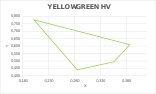
YELLOW -GREEN  FLUORESCENT

Acceptance Area

Luminance factor

Material Fluorescent min. 0.5

Combined material Min. 0.4

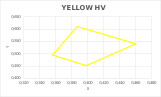
FLUORESCENT YELLOW

Acceptance Area

Luminance Factor

Fluorescent and Combined Material Min. 0.7

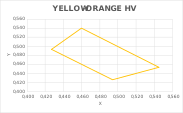
YELLOW – ORANGE FLUORESCENT

Acceptance Area


Luminance Factor

Fluorescent material min. 0.6

Combined Material Min. 0.5

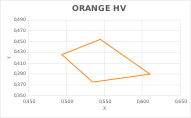
FLUORESCENT ORANGE

Acceptance Area

Luminance factor

Material Fluorescent min. 0.5

Combined material Min. 0.4

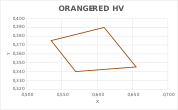
ORANGE -RED  FLUORESCENT

Acceptance Area

Luminance factor

Fluorescent Material and

Combined material Min. 0.4

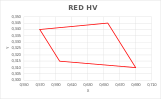
FLUORESCENT RED

Acceptance Area

Luminance factor

Fluorescent Material and

Combined material Min. 0.25

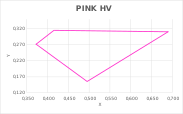
FLUORESCENT PINK

Acceptance Area

Luminance factor

Fluorescent material and combined material min. 0.3

PHOTOMETRIC REQUIREMENTS SEPARATE OR COMBINED MATERIAL REQUIREMENTS FOR NEW MATERIAL
According to CIE 54.2 Minimum coefficient of luminosity intensity

Type B1 (any color)

Viewing angle, α Input Angle, β
β 1 = 0°

β 2 = ± 5°

β 1 = ± 10°

β 2 = 0°

β 1 = 0°

β 2 = ± 20°

0,2° (12’) 560 350 280
0,33° (20’) 400 250 200
1,5° (1°30’) 20 10 10
Minimum RA Retroreflection Coefficient

Separate Material Type B2, B3 and AB

RA measured at 0 and 90°

See requirement in new material observation angle of 12′ and an entry angle of 5°

The orientation of the sensitive material must meet the photometric requirements at 1 of the 2 specified angles and must not be less than 75% of the table value at another rotation angle
Viewing angle, α Input Ampulus, β1 (β2 = 0)
5° 20° 30° 40°
12’ 330 290 180 65
20’ 250 200 170 60
1° 25 15 12 10
1°30’ 10 7 5 4
Minimum RA Retroreflection Coefficient

Combination Material Type AB

RA measured at 0 and 90°

See requirement in new material observation angle of 12′ and an entry angle of 5°

The orientation of the sensitive material must meet the photometric requirements at 1 of the 2 specified angles and must not be less than 75% of the table value at another rotation angle
Viewing angle, α Input Ampulus, β1 (β2 = 0)
5° 20° 30° 40°
12’ 65 50 20 5
20’ 25 20 5 1,75
1° 5 4 3 1
1°30’ 1,5 1 1 0,5
RETROREFLECTIVE REQUIREMENTS AFTER EXPOSURE REQUIREMENTS AFTER THE EXHIBITION
PHOTOMETRIC REQUIREMENTS

AFTER EXPOSURE

NEW MATERIAL type B1

According to CIE 54.2

Low temperature folding

(flexible samples)

RA measured at 0 and 90°

See requirement in new material

12′ observation angle and a 5° entry angle

Temperature variation

(flexible samples)

See requirement in new material

12′ observation angle and a 5° entry angle

Influence of precipitation

(flexible samples)

See requirement in new material

12′ observation angle and a 5° entry angle

Free fall

(rigid samples)

EN 60068-2-31

See requirement in new material

12′ observation angle and a 5° entry angle

Condition at -30 ± 2°C 4 h

Influence of water

(rigid samples)

Using the tested sample in free-fall test

See requirement in new material

12′ observation angle and a 5° entry angle

Photometric Testing

(rigid and flexible samples)

See requirement in new material

12′ observation angle and a 5° entry angle

PHOTOMETRIC REQUIREMENTS

AFTER EXPOSURE

NEW MATERIAL Type B2, B3, AB


Abrasion

(device and pledge)

EN ISO 12947-2

9 kPa

Measure after 5,000 cycles

See requirements in new material

Separated material: RA greater than 100 cd/(lx·m2) α = 12′ with an input angle β1 = 5° (β2 = 0°)

Combined material: RA greater than 30 cd/(lx·m2) α = 12′ with an input angle β1 = 5° (β2 = 0°)

The orientation of the sensitive material must meet the RA of the separated or combined material at 1 of the 2 specified angles and must not be less than 75 % of the table value at another rotation angle

Low temperature folding

(device and pledge)

ISO 4675

(-20 ± 2°C)

Refurbish at least 2 hours

No cracks or loss of surface area allowed

See requirements in new material

Separate material:

RA greater than 100 cd/(lx·m2) α = 12′ with an input angle β1 = 5° (β2 = 0°)

Combined Material:

RA greater than 30 cd/(lx·m2) α = 12′ with an input angle β1 = 5° (β2 = 0°)

The orientation of the sensitive material must meet the RA of the separated or combined material at 1 of the 2 specified angles and must not be less than 75 % of the table value at another rotation angle

Temperature variation

(device and pledge)

See requirements in new material

Separate material:

RA greater than 100 cd/(lx·m2) α = 12′ with an input angle β1 = 5° (β2 = 0°)

Combined Material:

RA greater than 30 cd/(lx·m2) α = 12′ with an input angle β1 = 5° (β2 = 0°)

The orientation of the sensitive material must meet the RA of the separated or combined material at 1 of the 2 specified angles and must not be less than 75 % of the table value at another rotation angle

Rainfall

(device and pledge)

EN ISO 20471 point 7.4.5

See requirements in new material

Separate material:

RA greater than 100 cd/(lx·m2) α = 12′ with an input angle β1 = 5° (β2 = 0°)

Combined Material:

RA greater than 15 cd/(lx·m2) α = 12′ with an input angle β1 = 5° (β2 = 0°)

The orientation of the sensitive material must meet the RA of the separated or combined material at 1 of the 2 specified angles and must not be less than 75 % of the table value at another rotation angle

Washing

(pledge)

See requirements in new material

Separate material:

RA greater than 100 cd/(lx·m2) α = 12′ with an input angle β1 = 5° (β2 = 0°)

Combined Material:

RA greater than 30 cd/(lx·m2) α = 12′ with an input angle β1 = 5° (β2 = 0°)

The orientation of the sensitive material must meet the RA of the separated or combined material at 1 of the 2 specified angles and must not be less than 75 % of the table value at another rotation angle

Dry cleaning

(pledge)

See requirements in new material

Separate material:

RA greater than 100 cd/(lx·m2) α = 12′ with an input angle β1 = 5° (β2 = 0°)

Combined Material:

RA greater than 30 cd/(lx·m2) α = 12′ with an input angle β1 = 5° (β2 = 0°)

The orientation of the sensitive material must meet the RA of the separated or combined material at 1 of the 2 specified angles and must not be less than 75 % of the table value at another rotation angle

GARMENTS

DESIGN

General requirements according to EN ISO 13688 in addition to those specific to this standard

Protective clothing should protect the torso, neck, arms up to the wrists, and legs up to the ankles during search and rescue activities other than fire.

Protective clothing must be made of materials that are resistant to accidental ignition fires. In addition, it must provide protection to the user against weather conditions, rough surfaces, as well as mechanical strength and visibility requirements.

Clothing may not restrict any movement to the wearer

If the protection is given by means of a 2-piece outer suit, the jacket must be superimposed on the pants at all times and in the face of any movement.

The pockets must be able to close completely. The flaps must be sewn or have the ability to close the pocket. The measurements of these flaps will be 20 mm wider than the opening (10 mm on each side) to prevent the flap from entering the pocket.

The zippers must have a protective flap on the outside of the garment. In the case of using buttons, their maximum distance will be 150 mm. In the case of using zippers, they must be able to be locked when they are completely closed.

The sleeves and bottoms of the pants must not have hems. They may have side openings which must have a means of closure and the opening and closure must be covered.

Protective clothing may not have sharp edges, roughness, or protrusions that could cause injury to the wearer.

The collar of the garment must remain upright when closed around the neck and must be able to open easily.

MARKING AND LABELLING

MARKING

-According to EN 13688

Type A                                                 Type B1, B2 or B3                    Type AB2 or AB3
for daytime running light                 for darkness                             for daylught and darkness

Compare
Add to wishlist
Category: Normative

Development and innovation of technical fabrics: THAT IS LENARD. Founded in 1996 by people with extensive experience in the textile sector, it has stood out since its beginning for a strong commitment to innovation and personal protection through the use of new fibers and manufacturing methods with the most advanced technology. Its wide range of fabrics offers protection for different sectors, complying with the requirements established by international certifications.

Latest news
  • 517 RP ANTISTATIC
    13 de May de 2026 No Comments
  • TECHTEXTIL 2026
    8 de April de 2026 No Comments
  • SAWO 2026
    25 de March de 2026 No Comments
  • Corporate video
    24 de February de 2026 No Comments

LENARD BCN, S.L.

Avda. Aragón nº37 - 22520 Fraga (Huesca)
info@lenard.tech
How to get

CENTRO OPERATIVO / HEADQUARTERS

Pol. Ind. Sot dels Pradals
C/ Sabadell, 3
08500 - Vic (Barcelona) Spain
How to get

LENARD MX, S de RL de CV

Rio Atoyac 30. Parque Industrial Empresarial Cuautlancingo
Cuautlancingo, 72730 Puebla (México)
+52 222 2319969
jisanchez@lenard.tech
How to get

LENARD USA CORP

2655-Lejeune Rd., Suite 810
Coral Gables, FL. 33134 (USA
+52 222 2319969
fcastejon@lenard.tech
How to get

LENARD Diseño web: Infoactiva't.
Aviso legal | Política de privacidad | Política de cookies
  • Start
  • About us
  • Products
    • Fabrics
      • Europe Catalog
      • America Catalog
    • ECO products
    • Accessories
    • Knitwear
  • Normative
  • Sustainability
  • Vídeos
  • News
    • Fairs
    • New products
    • Newsletter
    • Lenard MX
  • contact
  • English
  • French
  • German
  • Spanish
  • Wishlist
  • Compare
  • Login / Register
Start typing to see products you are looking for.

We are using cookies to give you the best experience on our website.

You can find out more about which cookies we are using or switch them off in .

Privacy Overview

This website uses cookies so that we can provide you with the best user experience possible. Cookie information is stored in your browser and performs functions such as recognising you when you return to our website and helping our team to understand which sections of the website you find most interesting and useful.

Strictly Necessary Cookies

Strictly Necessary Cookie should be enabled at all times so that we can save your preferences for cookie settings.

If you disable this cookie, we will not be able to save your preferences. This means that every time you visit this website you will need to enable or disable cookies again.

3rd Party Cookies

This website uses Google Analytics to collect anonymous information such as the number of visitors to the site, and the most popular pages.

Keeping this cookie enabled helps us to improve our website.

Please enable Strictly Necessary Cookies first so that we can save your preferences!