TEST TUBES
The specimen must be a complete garment or a composite sample comprising the constituent parts of the finished article, combined to constitute a representative whole in relation to the dimensions.
At least three specimens must be subjected to the washing and drying/finishing programs specified in this standard. The actual number of specimens must be determined according to the purpose of the material tests.
WASHING
-The washing procedure is selected according to the attached tables
-The specimens and the polish load are conditioned according to ISO 139. The mass of the conditioned specimen is determined.
-The specimens are added to the washing machine and the corresponding amount of ballast load is added to obtain a load appropriate to the dimensions of the machine and the load ratio.
-The instructions of the selected washing procedure are followed.
-Water is added, as well as detergent and additives according to the selected program.
-Acetic acid can be used in the last rinse to adjust the pH of the specimen. If used, the pH of the dry specimen should be noted in the report (this value should be between 5.5 – 7.0)
-Once the last centrifuge is finished, the specimens are removed taking care not to stretch or deform them. The mass of the washed specimens is determined in order to calculate their moisture rate by means of the following formula:
Where:
W: is the water retention of the textile (%)
m1: mass of the conditioned textile specimens (Kg)
m2: mass of textile specimens after drying (Kg)
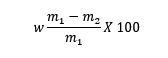
Table 1
Washing procedures for white work clothes and/or colour-sensitive trimmings.
Bleaching with peracetic acid
|
|
1. Full chargea |
2. Reduced loadb |
| Load Ratio |
1:12 |
1:17 |
| Agitation during heating, washing and rinsing |
Normal |
Normal |
| Washing |
|
Swim ratio* |
1:4 |
1:4 |
|
Detergents and additives |
4 g/l (see paragraphs 6.1.1
and 6.1.2)
2 g/l (see section 6.2) |
4 g/l (see paragraphs 6.1.1
and 6.1.2)
2 g/l (see section 6.2) |
|
Temperature |
75 ºC ± 2 ºC |
75 ºC ± 2 ºC |
|
Timec |
20 min |
20 min |
|
Cooling |
No |
Yes |
|
Drainage |
1 min |
1 min |
|
Intermediate Spin |
1 min |
No |
| Rinsing 1 |
|
Swim ratio* |
1:5 |
1:5 |
|
Timee |
3 min |
3 min |
|
Drainage |
1 min |
1 min |
|
Intermediate Spin |
1 min |
1 min |
| Rinse 2 |
|
Swim ratio* |
1:5 |
1:5 |
|
Timee |
3 min |
3 min |
|
Drainage |
1 min |
1 min |
|
Intermediate Spin |
1 min |
1 min |
| Rinse 3 |
|
Swim ratio* |
1:5 |
1:5 |
|
Timee |
3 min |
3 min |
|
Drainage |
1 min |
1 min |
|
Final spin (duration
estimated) |
6 min |
6 min |
|
Residual moisture |
50 – 55 % |
35 – 40 % |
| a For example, cotton
b For example, polyester/cotton
c Washing time begins when the temperature is reached
d Cooling: fill with cold water for approximately 10 minutes, in order to lower the temperature to a maximum of 55 °C (no more than 3 °C/min)
e The rinse time is counted from the moment the bath level is reached |
*Ratio of dry load to total amount of water (kg/l)
Table 2
Washing procedures with white work clothes. Chlorine bleaching
|
|
1. Full Chargea |
2. Reduced loadb |
| Load Ratio |
1:12 |
1:17 |
| Agitation during heating, washing and rinsing |
normal |
normal |
| Washing |
|
Swim ratio* |
1:4 |
1:4 |
|
Detergents |
4 g/l (see paragraphs 6.1.1 and 6.1.2) |
4 g/l (see paragraphs 6.1.1 and 6.1.2) |
|
Temperature |
85 ºC ± 2 ºC |
75 ºC ± 2 ºC |
|
Timec |
20 min |
20 min |
|
Coolingd |
no |
Yes |
|
Drainage |
1 min |
1 min |
|
Intermediate Spin |
1 min |
no |
| Rinsing 1 |
|
Swim ratio* |
1:5 |
1:5 |
|
Timee |
3 min |
3 min |
|
Drainage |
1 min |
1 min |
|
Intermediate Spin |
1 min |
1 min |
| Rinse 2 |
|
Swim ratio* |
1:5 |
1:5 |
|
Additives (chlorine) |
2 g/l (see section 6.3) |
2 g/l (see section 6.3) |
|
Timee |
3 min |
3 min |
|
Drainage |
1 min |
1 min |
|
Intermediate Spin |
1 min |
1 min |
| Rinse 3 |
|
Swim ratio* |
1:5 |
1:5 |
|
Additives (antichlorine) |
1 g/l |
1 g/l |
|
Timee |
3 min |
3 min |
|
Drainage |
1 min |
1 min |
|
Final spin (estimated time) |
6 min |
6 min |
|
Residual moisture |
50 – 55 % |
35 – 40 % |
| a For example, cotton
b For example, polyester/cotton
c Washing time begins when the temperature is reached
d Cooling: fill with cold water for approximately 10 minutes, in order to lower the temperature to a maximum of 55 °C (no more than 3 °C/min)
e The rinse time is counted from the moment the bath level is reached |
*Ratio of dry load to total amount of water (kg/l)
Table 3
Washing procedures for white work clothes and/or colour-sensitive trimmings.
Hydrogen peroxide
|
|
1. Full Chargea |
2. Reduced loadb |
|
Load Ratio |
1:12 |
1:17 |
|
Agitation during heating, washing and rinsing |
normal |
normal |
| Washing |
|
Swim ratio* |
1:4 |
1:4 |
|
Detergents and additives |
4 g/l (see paragraphs 6.1.1
and 6.1.2)
1 g/l (see section 6.4) |
4 g/l (see paragraphs 6.1.1
and 6.1.2)
1 g/l (see 6.4) |
|
Temperature |
85 ºC ± 2 ºC |
85 ºC ± 2 ºC |
|
Timec |
20 min |
20 min |
|
Coolingd |
No |
Yes |
|
Drainage |
1 min |
1 min |
|
Intermediate Spin |
1 min |
No |
| Rinsing 1 |
|
Swim ratio* |
1:15 |
1:15 |
|
Timee |
3 min |
3 min |
|
Drainage |
1 min |
1 min |
|
Intermediate Spin |
1 min |
1 min |
| Rinse 2 |
|
Liquid ratio |
1:15 |
1:15 |
|
Timee |
3 min |
3 min |
|
Drainage |
1 min |
1 min |
|
Intermediate Spin |
1 min |
1 min |
| Rinse 3 |
|
Swim ratio* |
1:5 |
1:5 |
|
Timec |
3 min |
3 min |
|
Drainage |
1 min |
1 min |
|
Final spin (estimated time) |
6 min |
6 min |
|
Residual moisture |
50 – 55 % |
35 – 40 % |
| a For example, cotton
b For example, polyester/cotton
c Washing time begins when the temperature is reached
d Cooling: fill with cold water for approximately 10 minutes, in order to lower the temperature to a maximum of 55 °C (no more than 3 °C/min)
e The rinse time is counted from the moment the bath level is reached |
*Ratio of dry load to total amount of water (kg/l)
Table 4
Washing procedure for coloured workgarments
|
|
1. Full Chargea |
2. Reduced loadb |
|
Load Ratio |
1:12 |
1:17 |
|
Agitation during heating, washing and rinsing |
normal |
normal |
| Washing |
|
Swim ratio* |
1:4 |
1:4 |
|
Detergents |
5 g/l (see paragraphs 6.1.1
and 6.1.2) |
5 g/l (see paragraphs 6.1.1
and 6.1.2) |
|
Temperature |
85 ºC ± 2 ºC |
75 ºC ± 2 ºC |
|
Timec |
20 min |
20 min |
|
Coolingd |
no |
Yes |
|
Drainage |
1 min |
1 min |
|
Intermediate Spin |
1 min |
no |
| Rinsing 1 |
|
Swim ratio* |
1:5 |
1:5 |
|
Timee |
3 min |
3 min |
|
Drainage |
1 min |
1 min |
|
Intermediate Spin |
1 min |
1 min |
| Rinse 2 |
|
Swim ratio* |
1:5 |
1:5 |
|
Timee |
3 min |
3 min |
|
Drainage |
1 min |
1 min |
|
Intermediate Spin |
1 min |
1 min |
| Rinse 3 |
|
Swim ratio* |
1:5 |
1:5 |
|
Timee |
3 min |
3 min |
|
Drainage |
1 min |
1 min |
|
Final spin (estimated time) |
6 min |
6 min |
|
Residual moisture |
50 – 55 % |
35 – 40 % |
| a For example, cotton
b For example, polyester/cotton
c Washing time begins when the temperature is reached
d Cooling: fill with cold water for approximately 10 minutes, in order to lower the temperature to a maximum of 55 °C (no more than 3 °C/min)
e The rinse time is counted from the moment the bath level is reached |
*Ratio of dry load to total amount of water (kg/l)
DRYING
-The entire load is dried following one of the two permitted procedures:
-Drum drying. Procedure A
Whole load (load ratio 1:25 to 1:35) with the outlet temperature regulated so as not to exceed 90 ºC. The dryer is allowed to run until the load is dry and the drying continues for 5 minutes after the heating (cooling) has stopped. The load is dry when the final moisture rate depending on the conditioned specimens is 0 ± 3 %.
-Tunnel/Closet Drying. Procedure B
The specimens, with the appropriate hangers, are placed in the preheated steam cabinet. The steam cabinet should operate at full load and with at least one load of ballast at the ends. The finisher must be set to 155 °C air temperature and a minimum operating time of 3 minutes
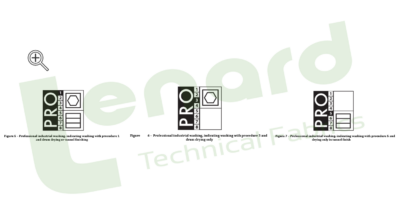
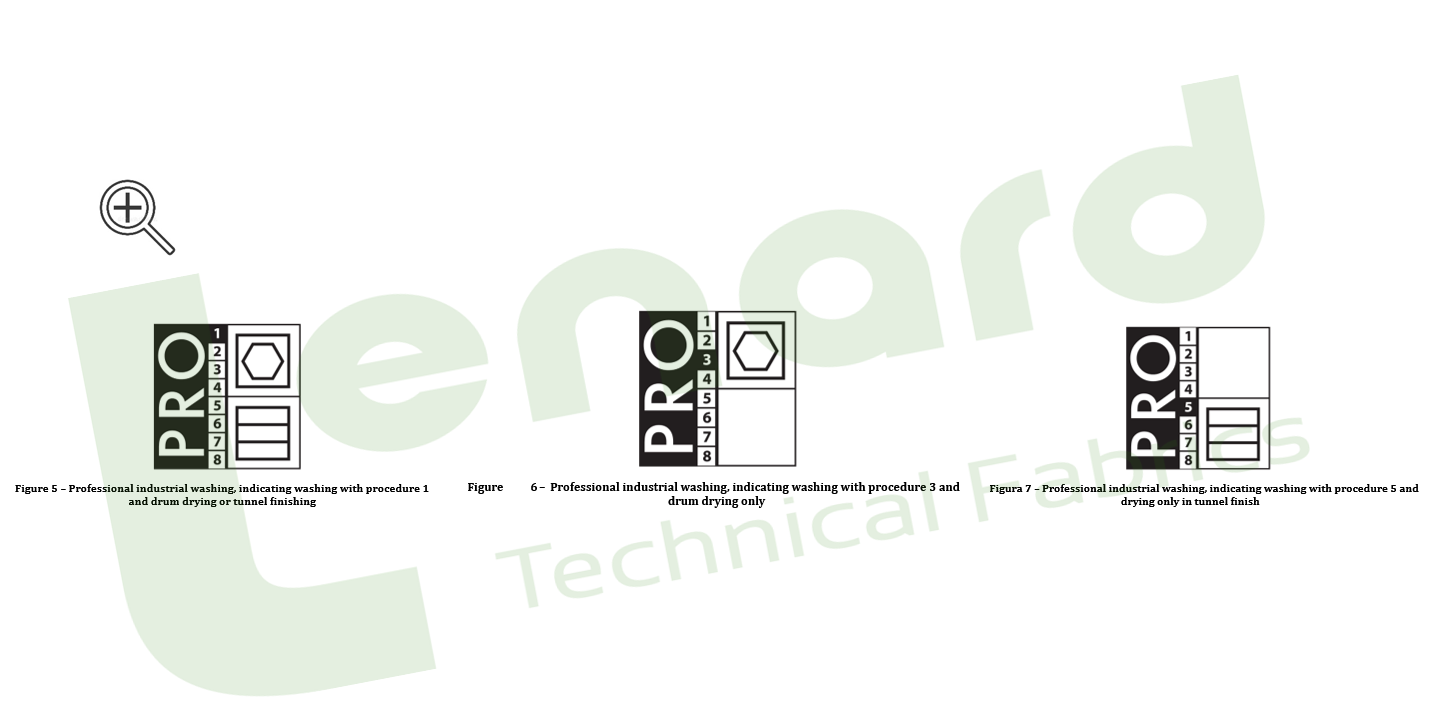
PICTOGRAMS ACCORDING TO EN ISO 30023