Sample conditioning according to ISO 139
WASHING PROCEDURE:
-Obtain a total dry load of 2.0 ± 0.2 kg (specimens + counterweights). If the complete garment is tested, the total load is recorded if it exceeds 2.2 kg. The selection of the counterweight will depend on the fibers of the sample:
-Type I counterweight for specimens with at least 51 % cellulosic fibers
-Type III counterweight for specimens with at least 51 % synthetic fibers
-Type II or III counterweight for specimens with other fibers or mixtures.
– Specimens should not make up more than half of the wash load if dimensional stability is to be determined.
-The washing procedure is selected. The specimens are weighed before washing and if necessary the counterweight is added to meet the required load of the washing machine. Mix the specimens evenly with the counterweights before loading them into the washing machine.
-Add the detergent:
-Type A washing machines: 20 ± 1 g in the dispenser. For delicate garments or wool 47 ± 1 g.
-Type B washing machines: 66 ± 1 g if it is reference detergent 1. If it is reference detergent 2 or 3, the right amount to obtain a foam with a height that does not exceed 3 ± 0.5 cm at the end of the washing cycle.
-Type C washing machine: 1.33 g/l of reference detergent 4 in the dispenser.
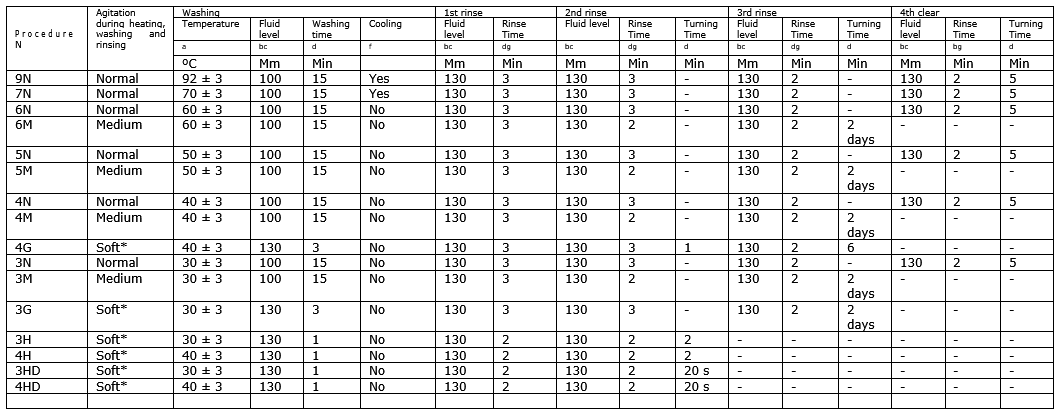
Washing procedure for type A washing machine:
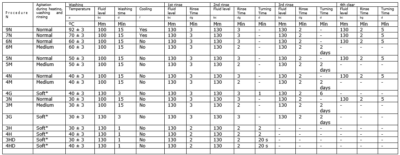
N → normal agitation: 12 s and 3 s static drum movement. High centrifugation
M → Medium Stirring: 8 s and 7 s static drum movement. Low centrifugation
G → Gentle stirring: 3 s and 12 s static drum movement. Low centrifugation
H → Simulated hand wash: gentle shaking: 3 s and 12 s static drum movement. Low centrifugation
HD → Washing machine water drain without spin extraction
a → The main washing temperature refers to the shut-off temperature
b → The liquid level is measured from the bottom of the drum after 1 min of operation and 30 s of stoppage
c → In type A1 washing machines: volume measurement is used for greater accuracy. See table B2 in the standard
d → A tolerance of ± 20 s can be applied at the indicated times
e → without agitation during heating of the water to the set temperature of -5 °C. From the set temperature -5 ºC, it is gently shaken. The expression “Very soft” in ISO 3758 corresponds to a “soft” in ISO 6330 for practical (mnemonic) reasons to remember the wash cycle.
f → Cooling: cold water up to 130 mm is added and stirred for an additional 2 minutes.
g → Rinse time is measured when the liquid level is reached
h → is heated to 40 ºC and kept for 15 min with agitation before heating to the washing temperature.
i → For safe laboratory practices only
j → Short spin
k → Drip Drying
Washing procedure for type B washing machines
| Cycle |
Normal |
Delicate |
Permanent ironing |
| Water level, l (gal) |
72 ± 4 (19 ± 1) |
| Stirring speed (strokes/min) |
86 ± 2 |
27 ± 2 |
86 ± 2 |
| Wash Time, min |
16 |
8.5 |
12 |
| Final spin speed (r/min) |
660 ± 15 |
500 ± 15 |
500 ± 15 |
| Final spin time (min) |
5 |
| Washing temperature ºC (ºF)a |
Cold: 27 ± 3 (80 ± 5) |
| Temper: 41 ± 3 (105 ± 5) |
| Hot: 49 ± 3 (120 ± 5) |
| Very hot: 60 ± 3 (140 ± 5) |
a → The temperatures in this table are similar to those specified by the US Federal Trade Commission for the verification of care labels. Because of the requirements of the DUL Department of Energy, many consumer washing machines use cooler water. An external control box can be used to override the set machine temperatures.
Washing procedure for type C washing machines
| Procedure
N |
Agitation in washing and rinsing |
Washing |
Rinse 1b |
Rinse 2b |
| Temperature |
Fluid level |
Washing time |
Turning Time |
Fluid level |
Time |
Turning Time |
Fluid level |
Time |
Turning Time |
| ºC |
I |
min |
min |
I |
min |
min |
I |
min |
min |
| a |
– |
– |
e |
– |
– |
e |
– |
– |
e |
| 4N |
NormalC |
40 ± 3 |
40 |
15 |
3 |
40 |
2 |
3 |
40 |
2 |
7 |
| 4M |
NormalC |
40 ± 3 |
40 |
6 |
3 |
40 |
2 |
3 |
40 |
2 |
3 |
| 4G |
NormalC |
40 ± 3 |
40 |
3 |
3 |
40 |
2 |
3 |
40 |
2 |
≤ 1 |
| 3N |
NormalC |
30 ± 3 |
40 |
15 |
3 |
40 |
2 |
3 |
40 |
2 |
7 |
| 3M |
NormalC |
30 ± 3 |
40 |
6 |
3 |
40 |
2 |
3 |
40 |
2 |
3 |
| 3G |
NormalC |
30 ± 3 |
40 |
3 |
3 |
40 |
2 |
3 |
40 |
2 |
≤ 1 |
| 4H |
Soft |
40 ± 3 |
54 |
6 |
2 |
54 |
2 |
2 |
54 |
2 |
≤ 1 |
a → The washing water is pre-heated to the designated temperature and supplied to the washing machine
b → For rinsing, cold water is used and supplied from a homemade tap
c → Normal agitation is the rotational action, such as a cycle, with a normal pulsation rate with agitation 0.8 s on and 0.6 s off, followed by reverse agitation for 0.8 s on and 0.6 s off.
d → The 4H procedure is simulated hand washing with gentle shaking that corresponds to the rotary action, like a cycle, with a gentle pulsation rate with shaking 1.3 s on and 5.8 s off, followed by reverse shaking for 1.3 s on and 5.8 s off.
e → In the 4H case the rotation corresponds to the lowest rotation of the drum speed during spinning, while in the rest of the case the rotation is the greater rotation.
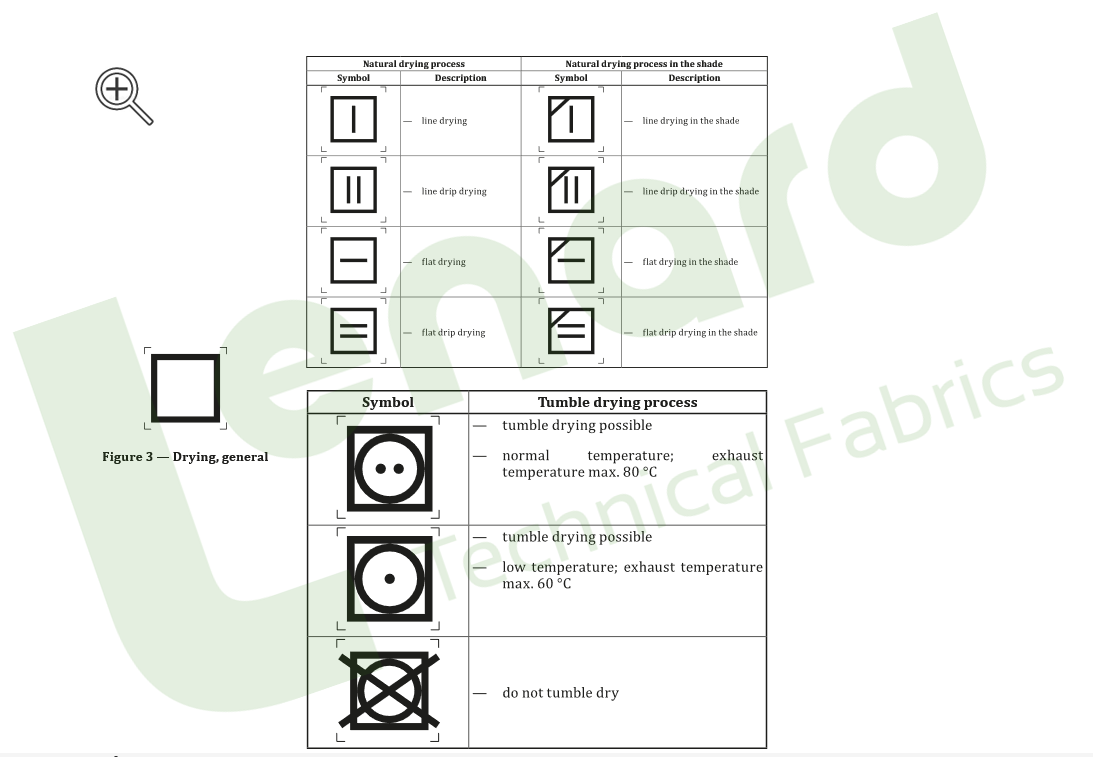
DRYING PROCEDURES:
-Once the washing is finished, the material is immediately removed and one of the drying procedures is followed:
-Procedure A Air drying. The warp must be vertical
-Procedure B Drip line drying.
-Procedure C Flat Drying
-Procedure D Flat drip drying
-Procedure E Drying on a plate
-Procedure F Drum Drying
-Once the washing cycle is finished, remove the load (cylinders and counterweights) and put it in the dryer. Ensure that the temperature of the evacuating air is regulated to at least 40 ºC without exceeding 80 ºC for a normal temperature and 60 ºC for a low temperature.
-If the end point of the drying cycle is a function of the moisture content and time fixation, it must have a humidity equivalent to that of the conditioned textile. Continue drying for 5 minutes with the heat off and remove the specimen.
-If the end point of the drying cycle is the over-drying and time-fixing state, this is characterized by drying until the final humidity is below the humidity of the conditioned textile. In these cases, the following percentages of final humidity will be applied:
-2 % for a textile composed of synthetic materials, in relation to the mass of the specimen put up.
-5 % for a textile composed of cellulosic materials, in relation to the mass of the conditioned specimen.
-For textiles made from other fibers and blends, consult appropriate resources for final moisture.
-If the moisture content at the end point is carried out by the dryer’s automatic sensor, it will dry until the sensor reaches the agreed level plus 5 min without heating.
-Dryer Cycle 1 for dry cotton with a final humidity of 0 ± 3 %
-Dryer cycle 2 for synthetics and blends with a final humidity of 2 ± 3 %
-Dryer cycle 3 for dry cotton for iron with a final humidity of 12 ± 3%
-For all textiles dried by fixing time, the end point should be between 0 % and -3 % of the conditioned mass:

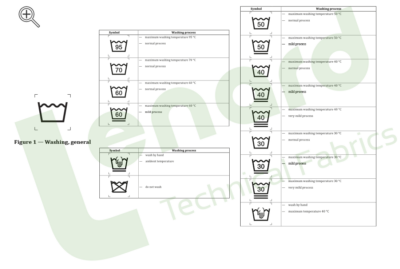
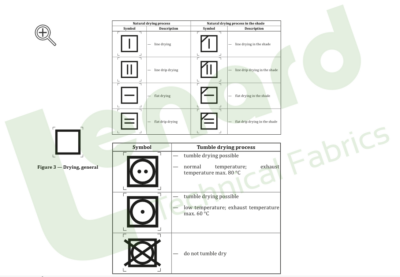
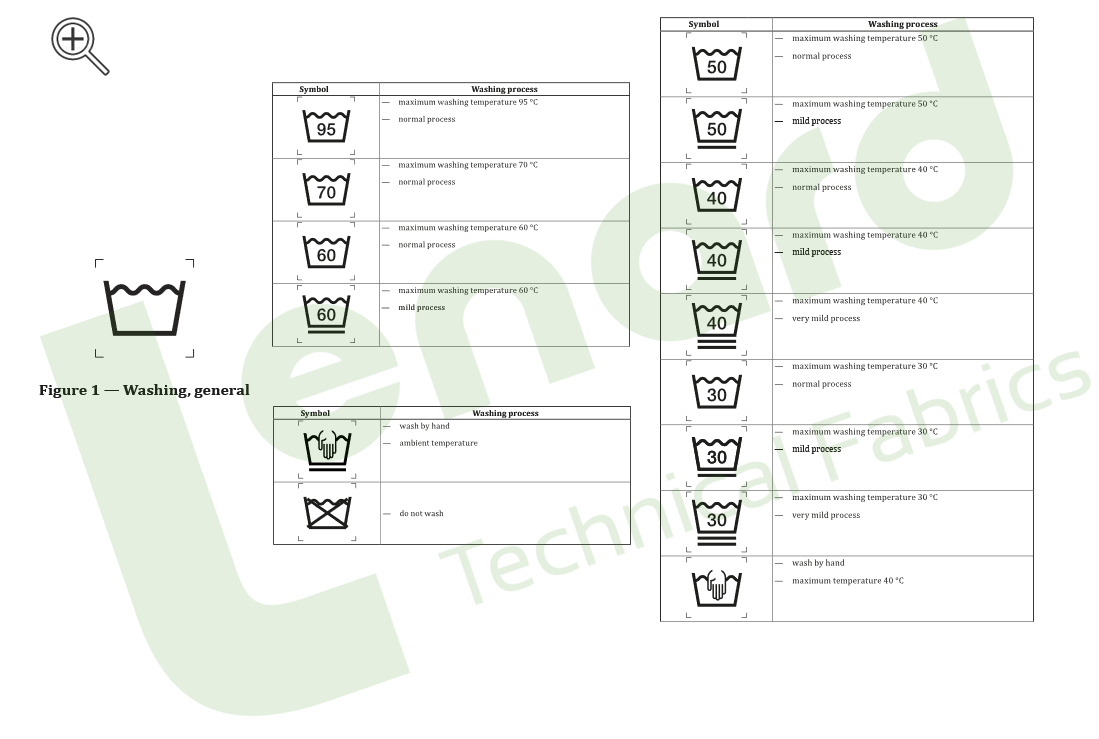
ISO 3758 PICTOGRAMS